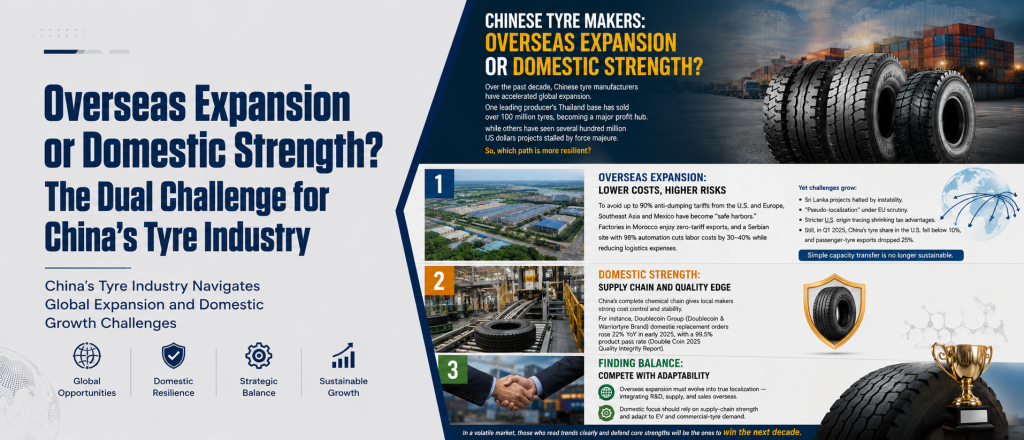
Over the past decade, Chinese tyre manufacturers have accelerated global expansion.
-
One leading producer’s Thailand base has sold over 100 million tyres, becoming a major profit hub.
-
while others have seen several hundred million US dollars projects stalled by force majeure.
So, which path is more resilient?
1. Overseas Expansion: Lower Costs, Higher Risks
-
To avoid up to 90% anti-dumping tariffs from the U.S. and Europe, Southeast Asia and Mexico have become “safe harbors.”
-
Factories in Morocco enjoy zero-tariff exports, and a Serbian site with 98% automation cuts labor costs by 30–40% while reducing logistics expenses.
Yet challenges grow:
• Sri Lanka projects halted by instability.
• “Pseudo-localization” under EU scrutiny.
• Stricter U.S. origin tracing shrinking tax advantages.
Still, in Q1 2025, China’s tyre share in the U.S. fell below 10%, and passenger-tyre exports dropped 25%.
Simple capacity transfer is no longer sustainable.
2. Domestic Strength: Supply Chain and Quality Edge
China’s complete chemical chain gives local makers strong cost control and stability.
For instance, Doublecoin Goup(Doublecoin & Warriortyre Brand) domestic replacement orders rose 22% YoY in early 2025, with a 99.5% product pass rate (Double Coin 2025 Quality Integrity Report).

3. Finding Balance: Compete with Adaptability
-
Overseas expansion must evolve into true localization — integrating R&D, supply, and sales overseas.
-
Domestic focus should rely on supply-chain strength and adapt to EV nd commercial-tyre demand.
In a volatile market, those who read trends clearly and defend core strengths will be the ones to win the next decade.