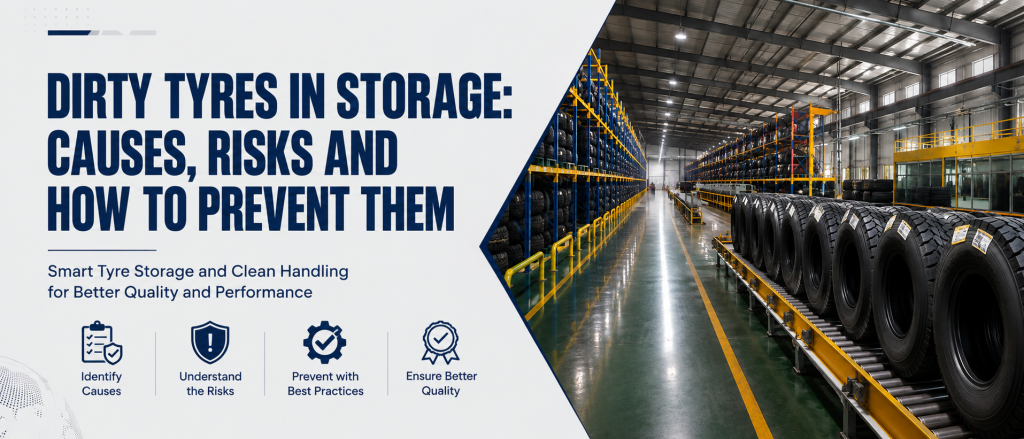
Tyre storage is far more than a logistics step—it directly affects tyre lifespan, performance, brand perception, and customer satisfaction.
Contamination, label issues, and poor packaging often create the well-known “dirty tyre” problem, leading to returns, complaints, and unnecessary cleaning costs.
1. Common “Dirty Tyre” Issues
-
Surface contamination (dust, oil stains, mold-release residue) affecting appearance and inspection.
-
Foreign objects trapped in tread grooves or the bead area, making display and sales difficult.
-
Labels that fall off, wrinkle, or are placed incorrectly, causing picking and shipping errors.
-
Improper banding or stacking that leaves scratches, marks, or minor deformation.

These issues reduce customer confidence and increase operational costs across the supply chain.
2. The Root Causes Behind Dirty Tyres
-
Production-stage contamination: dust, residue, manual handling, and tyre carcasses touching the floor.
-
Poor warehouse conditions: unstable temperature/humidity, dirty surfaces, moisture leading to bead rust.
-
Manual handling risks: dragging, dirty gloves, collisions with racks causing scratches or embedded debris.
-
Label and packaging inconsistencies: mislabeling, missing labels, or mixed batches leading to returns and complaints.
In short: “Dirty tyres” are not a cleaning issue—they’re a process issue.
3. HONSWAY’s End-to-End Clean Tyre System
HONSWAY tackles contamination and human error through a fully integrated smart-production and smart-storage approach.
• Intelligent Manufacturing Investment
A 126,500 m² smart plant (CNY 720 million investment, example data) designed for high automation and digital management.
• Full Barcode Traceability
Every stage—from raw materials to tyre carcass to finished tyre—is barcode-tracked for full lifecycle traceability.
• Fully “No-Floor-Contact” Production Flow
Rubber mixing, component preparation, building, and vulcanization operate with automated transfer systems.
Tyres move from vulcanization to inspection and labeling via robots and conveyors—no ground contact, no manual contamination.

• Smart Racking System
Structured storage with automated identification ensures safer, cleaner, and easier locating of specific SKUs.
• Environment Monitoring
Real-time temperature, humidity, smoke, and heat sensors minimize environmental risks and prevent contamination or degradation.
• Security & Access Control
CCTV + digital access logs + barcode entry records protect tyre inventory from damage, loss, or unauthorized handling.
• Temperature-Controlled Indoor Storage
Stable 0–25°C conditions, routine cleaning, no direct exposure to chemicals, and proper drainage reduce rust, aging, and dirt accumulation.

Smart production + smart warehousing = cleanliness built into the system, not left to manual cleaning.
Clean Tyres Are Not About Appearance—They Represent Quality and Capability
At HONSWAY, cleanliness is not a cosmetic touch-up—it is a measurable, trackable, enforceable standard embedded in the full production and storage flow.
Before a tyre reaches the customer, it has already achieved:
✓ stable quality
✓ consistent appearance
✓ zero-contamination handling
✓ reliable traceability

Cleanliness is the result, but capability is the foundation.
And capability determines how far a tyre brand can go.